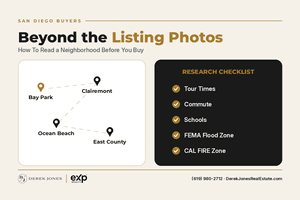
The photos look perfect: fresh paint, a sunny patio, maybe a sliver of ocean. But listing photos show a house, not a neighborhood. If you're wondering how to research a neighborhood before buying in San Diego, this guide walks you through the checks that matter: when to visit, how to test your commute, and where to look up schools, flood zones and fire hazard zones using official sources.
Whether you're looking in Bay Park, Clairemont, Ocean Beach, North County, South Bay or East County, the same rule applies. Love the house. Verify the neighborhood.
Why Listing Photos Aren't the Whole Story
Listing photos are taken to sell a home. They're shot at the best time of day, from the best angle, on a quiet afternoon. That's normal, but it means the photos can't tell you what the street sounds like on a Friday night, how long the drive is at 7:30 a.m., or whether the home sits in a mapped flood or fire hazard zone.
Those things shape your daily life, your insurance and your resale value. They're worth checking before you write an offer, not after.
Tour the Block at Different Times
One showing on a Saturday afternoon gives you one snapshot. Try to come back at least two or three more times.
Morning, evening and weekend
Weekday morning: school drop-off traffic, commuter cut-throughs, street sweeping.
Evening: lighting, parking availability, noise from nearby restaurants or bars.
Weekend: beach traffic, events, nightlife, neighbors' projects.
In coastal areas like Ocean Beach, a weekend afternoon can feel very different from a Tuesday morning.
Listen and look
Notice the things photos can't capture: aircraft noise, freeway hum, trains, leaf blowers, barking dogs. Check how well the homes and yards nearby are kept up.
Park where you'd actually park
Don't just pull into the driveway for the showing. Park where you'd park every day, whether that's on the street in Clairemont Hills or in a shared lot in South Bay, and walk to the front door. Is there room for guests? Are there permit or time limits?
Test Your Real Commute and Daily Errands
Don't trust "minutes to downtown"
A listing that says "15 minutes to downtown" usually means 15 minutes with no traffic. San Diego County traffic on corridors like I-5, I-8, I-805 and I-15 can change that a lot depending on the hour.
Map your actual routes
Put your real destinations into a map app: your job, your kids' school, the grocery store, the gym, daycare. Then drive or ride at least one of them at rush hour on a weekday. If you use transit, take the route once.
Daily life checks
How far is the nearest grocery store and pharmacy?
Is there a park or a safe walking route nearby?
Where's the closest urgent care or hospital?
Check Schools, Flood Zones and Fire Hazard Zones
This is the part I'd never skip. As a retired fire captain, I've learned that it's easier to plan around a hazard you've looked up ahead of time than one that catches you by surprise.
Schools: check by address, not by listing blurb
Listing descriptions sometimes name nearby schools, but attendance boundaries can change, and a school being close doesn't guarantee your address is assigned to it. Check with the school district directly. Within San Diego Unified, use the district's School Finder. Outside the city, go to the school district that serves that address and confirm your attendance area with them.
FEMA flood zones
The FEMA Flood Map Service Center is the official public source for flood hazard information produced in support of the National Flood Insurance Program. Enter the address to see its official flood map. Maps are continually updated, so look at the current map, not an old screenshot. If a home is in a high-risk flood zone and you're using a federally backed mortgage, your lender may require flood insurance. Ask your lender early.
CAL FIRE Fire Hazard Severity Zones
CAL FIRE's Office of the State Fire Marshal maps Fire Hazard Severity Zones as Moderate, High or Very High. You can enter an address in their online viewer. For in-city areas, also check with that local jurisdiction.
Important: these maps measure hazard, not risk. Hazard is based on things like vegetation, terrain and fire weather. Risk accounts for mitigation such as defensible space and home hardening.
Insurance and disclosures
Get homeowners insurance quotes early, ideally during your inspection period, not the week before closing. The California Department of Insurance wildfire readiness page has consumer resources. You'll also get seller disclosures, including natural hazard information, during escrow. Read them carefully and ask questions.
Ask Locals and Your Agent
What to ask neighbors
If someone is out walking a dog or watering a yard, ask them:
How's parking at night?
Is it noisy on weekends?
Anything you wish you'd known before moving here?
What to ask about HOAs
For condos and planned communities, ask for HOA rules, dues history and parking policies. Look for any pending special assessments or restrictions on rentals, pets or remodels.
What your agent can help with
A local agent can pull recent comparable sales, point out signs of unpermitted additions worth asking about, and explain how micro-markets differ from Ocean Beach to East County. Two homes a mile apart can have very different values, commutes and hazard profiles.
Your Neighborhood Research Checklist
Visited on a weekday morning, an evening and a weekend
Parked and walked like a resident
Drove the real commute at rush hour
Confirmed the assigned school with the district (School Finder for San Diego Unified)
Checked the FEMA flood map for the address
Checked the CAL FIRE Fire Hazard Severity Zone viewer
Got insurance quotes early (CA Dept. of Insurance)
Read the disclosures and HOA documents
Talked to a neighbor or two
Reviewed comps with your agent
Frequently Asked Questions
How do I research a neighborhood before buying a home in San Diego?
Visit at different times of day, drive your real commute at rush hour, confirm schools with the district, check the FEMA flood map and the CAL FIRE Fire Hazard Severity Zone viewer for the address, get insurance quotes early, and talk with neighbors and your agent.
How do I check if a San Diego home is in a fire hazard severity zone?
Enter the address in CAL FIRE's Fire Hazard Severity Zone viewer. Zones are rated Moderate, High or Very High. For areas under local responsibility, also check with the local jurisdiction.
How do I check if a home is in a FEMA flood zone?
Search the address on the FEMA Flood Map Service Center. Maps are updated over time, so always check the current version.
How do I find which school a San Diego address is assigned to?
Ask the school district that serves the address. San Diego Unified has an online School Finder. Don't rely on the school names in a listing description.
Should I visit a neighborhood at different times before buying?
Yes. Traffic, parking, noise and activity can change a lot between a weekday morning, an evening and a weekend, especially near the coast or busy corridors.
Does a fire hazard zone mean I can't get insurance?
Not necessarily. Insurers use their own models. Get quotes early, ask about wildfire mitigation discounts, and talk with a licensed insurance agent. See also the California Department of Insurance wildfire readiness resources.
Love the House. Verify the Neighborhood.
Looking at a specific San Diego zip, from Bay Park and Clairemont to Ocean Beach, North County, South Bay or East County? Tell me which one, and I'll help you dig into the block, the commute, the comps and the hazard maps before you make an offer.
Call or text Derek at (619) 980-2712 or visit derekjonesrealestate.com.
Derek Jones, REALTOR® | eXp Realty of Southern California, Inc. | DRE #02167577
Sources
This article is general education, not legal, insurance or lending advice. Confirm details with the appropriate agency, district, insurer or lender.